ER 2553 Welding Wire Manufacturer Supplier & Exporter in Auckland, New Zealand
ER 2553 Welding Wire in Christchurch, ER 2553 Filler Welding Wire Stockist, ER 2553 Inert Gas Welding Wire in Auckland, New Zealand.
Table of Contents
ER 2553 Welding Wireis a premium welding consumable engineered for welding and surfacing stainless steels, especially duplex and super duplex grades. Recognized for its outstanding corrosion resistance and superior strength, this wire suits challenging industrial uses, such as chemical processing, oil and gas, and marine settings. ER 2553 delivers exceptional weld soundness and long-lasting performance, making it a dependable option for essential welding projects.
ER 2553 Welding Wire Specifications
Classification
AWS A5.9, ER 2553
Form
MIG spools, TIG cut lengths, Reels and Coils
Type Of Welding
Inert Gas Welding
Current
MIG-DCEP / TIG-DCEN
Size
0.76 mm ∞ *4.70xmm
ER 2553 Welding Wire Application & uses
Petroleum
Chemical plant
Power sector
Gas Industry
Hardware tools
Metallurgy
Machinery
Construction
Shipbuilding
ER 2553 Welding Wire Chemical Composition
C
Cr
Ni
Mo
Mn
Si
P
S
Cu
N
ER 2553
0.04
24.0–27.0
4.5-6.5
2.9-3.9
1.5
1.0
0.04
0.03
1.5–2.5
ER 2553 Welding Wire Mechanical Properties
0.2% proof stress,
Rp0.2%:
Tensile strength,
Rm:
Elongation,
4d/5d:
Impact ISO-V,
-45°C:
≥550MPa
≥750MPa
≥20%
≥45J (TIG), ≥27J (MIG).
ER 2553 Welding Wire in Christchurch, Supplier of ER 2553 TIG Welding Wire, ER 2553 Inert Gas Welding Wire in Christchurch, New Zealand.
Top ER 2553 Welding Wire Manufacturing Company in Auckland
At Koasteel, we’re proud to be the largest supplier and manufacturer in the New Zealand, delivering advanced solutions for every one of your piping requirements. With modern production facilities strategically situated in the New Zealand, we maintain an extensive stock of more than 25,000 tons of top-grade materials on hand and ready to ship.
Reach out to us for a fast quote tailored to your requirement.
We provide these ER 2553 Welding Wire in compliance with DIN, ISO, JIS or ANSI Standard.
High Temperature ER 2553 Welding Wire in ABU Dhabi, ER 2553 Inert Gas Welding Wire Manufacturer & Stockist in Auckland, New Zealand.
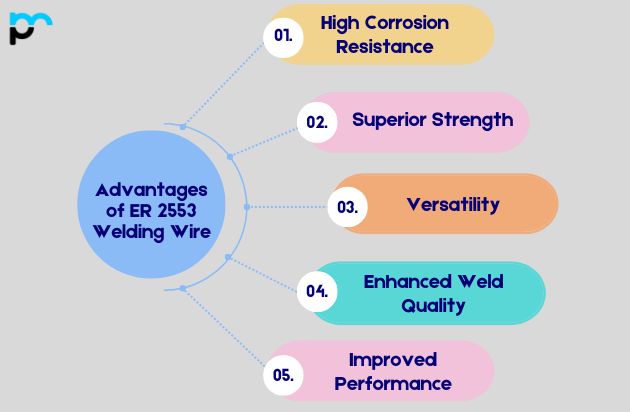
Advantages of ER 2553 Welding Wire
High Corrosion Resistance: ER 2553 welding wire delivers outstanding corrosion resistance, making it well-suited for demanding environments like chemical processing and marine applications.
Superior Strength: With high tensile and yield strength, this welding wire produces durable, robust welds that hold up in tough industrial applications.
Versatility: Designed for welding duplex and super duplex stainless steels, ER 2553 is adaptable and finds use across many industries, including oil and gas and petrochemical.
Enhanced Weld Quality: ER 2553 delivers smooth, uniform welds with few defects, supporting high-quality and dependable joint integrity.
Improved Performance: The composition of the wire boosts its performance, offering superb toughness and protection against stress corrosion cracking, which is vital for critical welding projects.
Types of ER 2553 Welding Wire
ER 2553 Welding Wire
ER 2553 Inert Gas Welding Wire
Galvanized Hex Lag Bolts
ER 2553 Inert Gas Welding Wire
High Temperature ER 2553 Welding Wire
AWS Class ER 2553 Consumable Welding Wire
AWS Class ER 2553 Consumable Welding Wire, UNS S32520 IABCO MIG Filler Wire Exporter in Christchurch, New Zealand.
Application Industry
ER 2553 Welding Wire uses are as varied as the sectors they support, led mainly by the aerospace, railway, construction and automotive fields, along with petrochemical, nuclear, medical, Oil & Gas, Chemical, Pharmaceutical, Food & Beverage, Nuclear, Thermal Power plants, Paper and Pulp, marine and mining, and more.
Automotive Industry
Construction Sector
Aerospace Applications
Oil and Gas Industry
Are ER 2553 Welding Wire Susceptible to Galvanic Corrosion?
ER 2553 welding wire, made for duplex and super duplex stainless steels, typically withstands galvanic corrosion because of its strong corrosion resistance characteristics. Nevertheless, as with any metal, it may become vulnerable when placed in direct contact with a notably different metal while an electrolyte is present. Choosing the right materials and applying isolation methods are crucial to avoid galvanic corrosion in mixed-metal uses.