
Set out on a path of superb durability and adaptability with our Incoloy Forgings, thoughtfully custom-built to excel in the toughest industrial settings. Crafted with painstaking attention to detail and reinforced with outstanding strength, our Incoloy stainless steel forgings set a new standard for reliability in critical applications. Boasting unrivaled corrosion resistance and lasting toughness, our forgings surpass ordinary options, delivering dependable performance where others fall short. From high-temperature uses in aerospace engineering to corrosive chemical processing in industrial plants, our extensive selection of Incoloy Forgings guarantees lasting resilience and reliable functionality. Dedicated to exceeding customer expectations, we offer tailored solutions, competitive pricing, and rapid delivery, ensuring smooth integration into your projects with precision and efficiency. Rely on our top-grade forgings, backed by a steadfast commitment to quality and performance, to raise your ventures to unmatched heights of success.
| Specifications | ASTM B564, ASME SB564 |
|---|---|
| Standard | DIN, ASTM, BS and all International Standards |
| Flat bar blocks | up to 27″ width and 15,000 lbs |
| Cylinders and sleeves | up to 50″ maximum O.D. and 65″ maximum length |
| Discs and hubs | up to 50″ diameter and 20,000 lbs |
| Rolled, hand forged or mandrel forged rings | up to 84″ maximum O.D. and 40″ maximum length |
| Rounds, shafts and step shafts | up to 144″ maximum length and 20,000 lbs |
| Forging Types | Impression Die Forging, Open Die Forging, Seamless Rolled Forging, Hot Forging, Cold Forging, Open die hammer forging, Impression die drop forging, Closed Die Forging, Press Forging, Upset Forging, Compression Forging, Swaging, Rotary Forging, Roll forging. |
| Grade | Ni | Cr | Fe | Mo | Cu | Ti | Al | Mn | Si | Nb | C | S |
| Incoloy Forging | 42.0-46.0 | 19.5-22.5 | Min 22 | 2.5-3.5 | 1.5-3.0 | 1.9-2.4 | 0.1-0.5 | Max 1.0 | Max 0.5 | Max 0.5 | Max 0.03 | Max 0.03 |
At Koasteel, we take great pride in being the largest supplier and manufacturer in the New Zealand, delivering advanced solutions for every one of your piping requirements. Thanks to our modern production facilities strategically situated in the New Zealand, we maintain an extensive stock of more than 25,000 tons of top-quality materials kept ready in inventory.
Reach out to us for a fast quote tailored to your requirement.
These Incoloy Forgings are supplied by us in accordance with DIN, ISO, JIS or ANSI Standard.
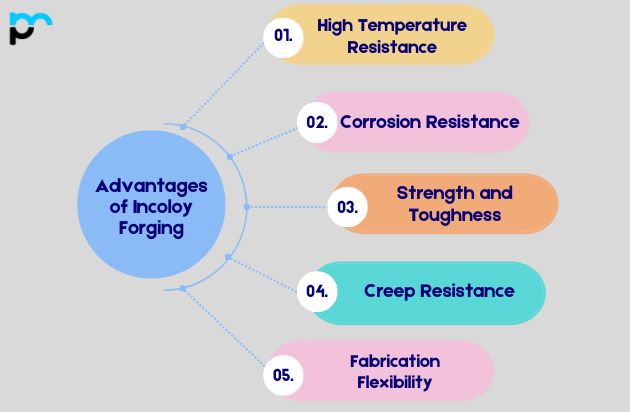
Incoloy Forging uses are as varied as the sectors they support, led mainly by the aerospace, railway, construction and automotive sectors, along with petrochemical, nuclear, medical, Oil & Gas, Chemical, Pharmaceutical, Food & Beverage, Nuclear, Thermal Power plants, Paper and Pulp, marine and mining, etc.
Corrosion Resistance: Evaluate the setting where the forgings will be deployed. Take into account any corrosive agents present, such as acids, alkalis, saltwater, or other chemicals. Pick an Incoloy alloy that delivers suitable corrosion resistance for those particular conditions.
Temperature Resistance: Identify the range of operating temperatures for your application. Various Incoloy alloys provide different degrees of heat resistance. Opt for a forging material capable of enduring the temperatures met during operation without weakening its mechanical properties.
Mechanical Properties: Take into account the mechanical demands of your application, such as tensile strength, yield strength, ductility, and toughness. Pick an Incoloy alloy and forging process able to deliver the required mechanical properties to endure the intended loads and stresses.
Fabrication Requirements: Assess the intended shape, size, and complexity of the forgings required for your application. Pick a forging technique (such as open die forging or closed die forging) and Incoloy grade that can support the necessary fabrication processes while preserving dimensional accuracy and structural integrity.
Yes,Incoloy forgings are recyclable once they have been used. The alloy can be melted down and repurposed to produce new forgings or other items, supporting sustainability and resource conservation initiatives across a range of industries. Recycling helps cut down on waste and lessens the reliance on virgin materials during manufacturing processes.
Incoloy forgings are typically discouraged for hygienic and sanitary uses because of the risk of nickel and other alloying elements leaching out. Stainless steel is frequently the preferred choice due to its better corrosion resistance and its suitability for the demanding cleanliness standards found in sectors like food processing, pharmaceuticals, and healthcare.
Yes,Incoloy forgings may be prone to galvanic corrosion when they touch dissimilar metals within an electrolyte. It is important to carefully evaluate material compatibility and use suitable isolation methods to reduce the risk of galvanic corrosion in applications involving several metals.
Yes,Incoloy forgings are suitable for underground use, as long as they receive adequate corrosion protection. The corrosion resistance of Incoloy makes it a good fit for underground piping systems, chemical storage tanks, and similar infrastructure that may be subjected to soil and moisture, when the right corrosion protection measures are applied.
Mail: sales@koasteel.nz